
Riftbound: Promising Future 101
A must-read reference guide for precisely mastering the resolution order of Promising Future — the most complex card to adjudicate in the current meta — and avoiding chain-handling mistakes that can cost you the game.
# Riftbound: Promising Future 101
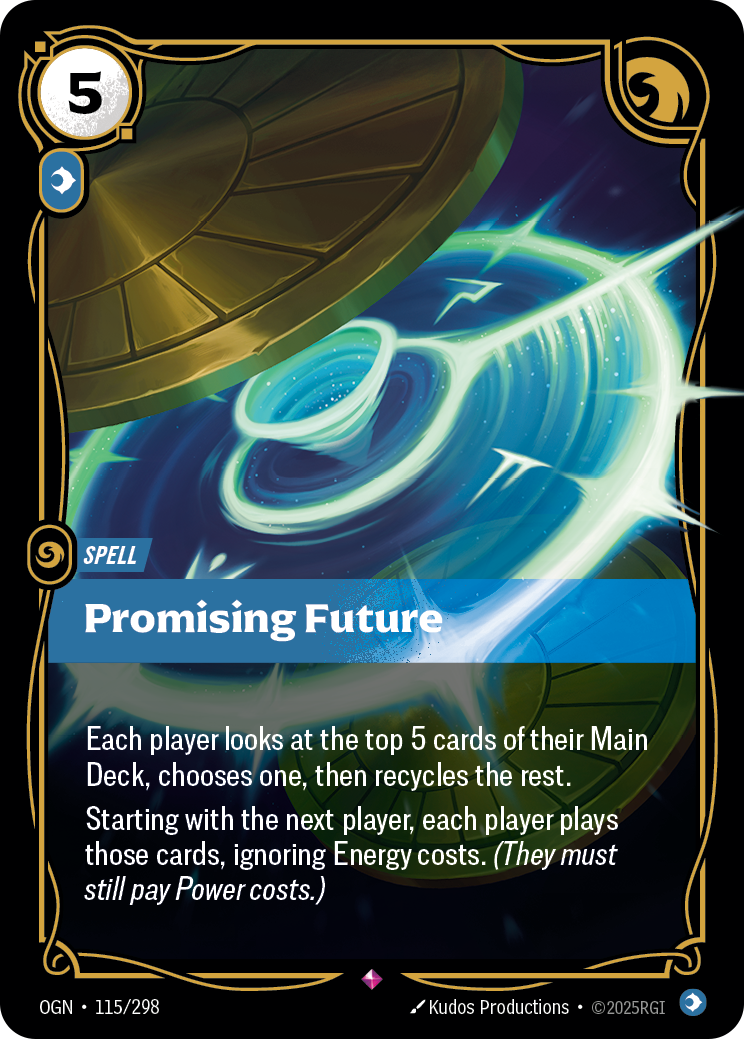
Vendetta (Set 4) release is on the horizon and we have seen the rise of a notably complicated card: Promising Future (in decks like Jayce Aurora & Lux Infinite). I figured it is now time to do a crash course on how to resolve Promising Future and the process of how to handle the chain afterward.
For those that don't remember, I was one of the judges who oversaw the match between Relivia and Alanzq at Hartford. Relivia plays Promising Future in what I believed was the first time in a feature match. Looking back at the VOD, the process of play was still technically slightly imprecise but the end result was the same (which is what matters the most).
For this article, I am going into extreme detail so that people understand every single step that goes behind this card. This card is going to be pretty prominent in the upcoming meta, and I want to make sure both players and judges know how to handle it.
## Preface
### Errata
This is now the official printed text for Promising Future:
> "Each player looks at the top 5 cards of their Main Deck, banishes one of them, then recycles the rest. Starting with the next player, each player plays those cards, ignoring Energy costs. (They must still pay Power costs.)"
This errata is important because it adds an extra step that changes how players will play around the card.
### Acronyms/Meanings
- Turn Player - The one who played Promising Future. Will be known as Player A.
- Next Player - Typically the enemy in 1v1, or the next player in Turn Order for other game modes. Will mostly be known as Player B.
- WYPM - "When you play me"
- FFA - Free For All (the game mode)
### For multiple game modes:
- 1v1 - We can assume that Player A plays Promising Future, and Player B is their enemy. Turn order is: (A -> B)
- 2v2, We can assume Player A1 plays Promising Future, with Player A2 as their partner, and enemies Player B1 & B2. Turn order is: (A1 -> B1 -> A2 -> B2)
- FFA - We can assume that Player A plays Promising Future, with enemies Players B, C, and D. Turn order is: (A -> B -> C -> D)
## The chain
When illustrating the chain, I will use square brackets [] and when an item has a ~ appended, that indicates it is pending.
### 1) Look at top 5 cards
All players will do this. Not much more to explain.
### 2) Choose the card and banish it (a.k.a. reveal it)
Starting with the Turn Player (who played Promising Future), they will choose one of the 5 cards and banishes it. Because the Banishment Zone is public, ***that card is revealed for everyone else to see***. The player then recycles the other 4 cards. The order of revealing follows the Turn Order:
- 1v1 - A -> B
- 2v2 - A1 -> B1 -> A2 -> B2
- FFA - A -> B -> C -> D
That does mean everyone else will get to see what the Turn Player picks and can make an informed decision based on the choices of the players before them.
### 3) Play the chosen cards (build the chain of PENDING items)
Once everyone has picked and revealed their card, this is where things get funky. ***Starting*** with the Next Player, each player plays their chosen card and adds it to the chain as a pending item. Do NOT 1) pay Power costs and 2) resolve those cards right away.
We want to build the chain first! What I recommend is physically piling the cards on top of one another in the following order. This also represents what the chain looks like after everyone has played their card:
- 1v1 - [B~, A~]
- 2v2 - [B1~, A2~, B2~, A1~]
- FFA - [B~, C~, D~, A~]
### 4) Promising Future resolves (i.e. Jhin/Lux triggers now)
If you have any abilities that trigger from playing cards (i.e. Jhin or Lux), those triggers are added now as pending items on top of the existing chain.
For example, in 1v1, if I am the Turn Player and I am playing Lux, the chain would currently look like this:
[B~, A~, A-Lux~]
### 5) Finalize each card/item (pay Power costs, make choices, trigger WYPMs)
Now we look at a list of pending items on the chain (~~ungodly long if 2v2/FFA~~). We finalize those items from the bottom to the top (do not confuse this with resolving the chain, which happens from the top to the bottom). That means the Next Player's item is finalized first. Let's look at some 1v1 scenarios:
#### Both cards are spells
Next Player will pay the Power cost first and make their choices. After that, Turn Player will pay the Power cost and make their choices.
- Initial chain. [B~, A~]
- Spell B finalizes first. Next Player makes choice(s). [B, A~]
- Spell A finalizes next. Turn Player makes choice(s). [B, A]
Pretty straightforward.
#### Both cards are unit/gear (and what if they have WYPMs)
The Next Player finalizes their Unit/Gear first; pay the Power cost and choose a valid location. It immediately resolves and enters the board. The Turn Player then does the same thing, meaning their Unit/Gear enters the board second. If either of those cards has a WYPM trigger, that trigger is added to the chain as a pending item.
If both Units/Gear have WYPMs, the chain would look like this step by step:
- Initial chain. [B-U/G~, A-U/G~]
- Unit/Gear B finalizes first and resolves immediately; enters the board. Adds WYPM trigger. [A-U/G~, B-WYPM~]
- Unit/Gear A finalizes next and resolves immediately; enters the board. Adds WYPM trigger. [B-WYPM~, A-WYPM~]
- WYPM from Unit/Gear B finalizes next; Next Player makes choice(s). [B-WYPM, A-WYPM~]
- WYPM from Unit/Gear A finalizes next; Turn Player makes choice(s). [B-WYPM, A-WYPM]
#### Next Player card is unit/gear, Turn Player card is spell
The Next Player finalizes the unit/gear first; pay the Power cost and choose a valid location. It will immediately resolve and enter the board (if applicable, add WYPM trigger). Turn Player will pay the Power cost next and make their choices. Since the Next Player's unit/gear has already entered the board, Turn Player is allowed to choose it.
If Next Player unit/gear has a WYPM, here is the chain step by step:
- Initial chain. [B-U/G~, A~]
- Unit/Gear B finalizes first and resolves immediately; enters board. Adds WYPM trigger. [A~, B-WYPM~]
- Spell A finalizes next, Turn Player makes choice. [A, B-WYPM~]
- Next Player finalizes WYPM triggers; makes choice(s). [A, B-WYPM]
#### Next Player card is spell, Turn Player card is unit/gear
The Next Player will first pay the Power cost of spell and make their choices now. Since the Turn Player's unit/gear from Promising Future has not entered the board yet, the Next Player CANNOT choose it. The Next Player will finalize the unit/gear first; pay the Power cost and choose a valid location. It immediately resolves and enters the board (if applicable, add WYPM trigger).
If Turn Player unit/gear has a WYPM, here is the chain step by step:
- Initial chain. [B~, A-U/G~]
- Spell B finalizes first, Next Player makes choice(s). [B, A-U/G~]
- Unit/Gear A finalizes next and resolves immediately; enters board. Adds WYPM trigger. [B, A-WYPM~]
- Turn Player finalizes WYPM triggers; makes choice(s). [B, A-WYPM]
### 6) Resolve chain items
Now that everything has become a finalized chain item, you finally resolve the remaining chain items from the top to the bottom (and also do your normal priority window if any player wants to play more Reactions on top). That means ~80% of the time, the Turn Player will usually have their chain item as the topmost (assuming they played a spell or unit with WYPM).
For a better step by step, there are detailed examples further below to see how the chain items would resolve.
## Examples
### Example 1 (1v1 - Lux)
Turn Player is Lux and plays a Promising Future; it resolves. Turn Player chooses Progress Day. Next Player chooses Sabotage.
- Initial chain as Promising Future resolves. Turn Player banishes Progress Day. Next Player banishes Sabotage. []
- Next Player plays Sabotage first. [B-Sabo~]
- Turn Player plays Progress Day next. [B-Sabo~, A-PDay~]
- Promising Future resolves; Turn Player triggers Lux. [B-Sabo~, A-PDay~, A-Lux~]
- Next Player finalizes Sabotage; pays 1 Power. [B-Sabo, A-PDay~, A-Lux~]
- Turn Player finalizes Progress Day; pays 1 Power. [B-Sabo, A-PDay, A-Lux~]
- Turn Player finalizes Lux trigger. [B-Sabo, A-PDay, A-Lux]
- Turn Player resolves Lux; draw 1. [B-Sabo, A-PDay]
- Turn Player resolves Progress Day; draws 4. [B-Sabo]
- Turn Player triggers Lux (again) from resolving Progress Day. [B-Sabo, B-Lux~]
- Turn Player finalizes Lux trigger. [B-Sabo, B-Lux]
- Turn Player resolves Lux; draw 1. [B-Sabo]
- Next Player resolves Sabotage and (in full glory) sees the newly drawn cards. []
### Example 2 (1v1 - Aurora vs. Salvage)
Turn Player plays a Promising Future; it resolves. Turn Player chooses Dazzling Aurora. Next player chooses Salvage.
- Initial chain as Promising Future resolves. Turn Player banishes Dazzling Aurora. Next Player banishes Salvage. []
- Next Player plays Salvage first. [B-Salv~]
- Turn Player plays Aurora next. [B-Salv~, A-Aurora~]
- Promising Future resolves. Next Player finalizes Salvage first; pays 1 Power and realizes they can't target Aurora. They cry in sadness. [B-Salv, A-Aurora~]
- Turn Player finalizes Aurora next; pays 2 Power and immediately resolves. Aurora enters board. They cry in joy. [B-Salv]
- Next Player resolves Salvage. Doesn't kill any gear. Draws 1. []
### Example 3 (1v1 - Aurora vs. Ravenbloom Prefect)
Turn Player plays a Promising Future; it resolves. Turn Player chooses Dazzling Aurora. Next player chooses Ravenbloom Prefect.
- Initial chain as Promising Future resolves. Turn Player banishes Dazzling Aurora. Next Player banishes Ravenbloom Prefect. []
- Next Player plays Ravenbloom Prefect first. [B-Prefect~]
- Turn Player plays Aurora next. [B-Prefect~, A-Aurora~]
- Promising Future resolves. Next Player finalizes Ravenbloom Prefect first; it immediately resolves and enters the board. [A-Aurora~]
- Turn Player finalizes Aurora next; pays 2 Power and immediately resolves. Aurora enters the board. Ravenbloom Prefect triggers and Next Player decides to add it to the chain. [B-Prefect-Effect~]
- Ravenbloom Prefect play trigger finalizes; no choices are made as it is a programmatic selection. [B-Prefect-Trigger]
- Ravenbloom Prefect play trigger resolves; it banishes itself and banishes Aurora. Turn Player cries on how far behind they are now. []
### Example 4 (1v1 - Double Star-Crossed)
Board state: Turn Player has Unit A1, Next Player has Unit B1 and B2. Turn Player plays Promising Future; it resolves. Turn Player chooses Star-Crossed. Next Player also chooses Star-Crossed.
- Initial chain as Promising Future resolves. Turn Player banishes Star-Crossed. Next Player sees and also decides to banish Star-Crossed. []
- Next Player plays Star-Crossed first. [B-Star~]
- Turn Player plays Star-Crossed next. [B-Star~, A-Star~]
- Promising Future resolves. Next Player finalizes Star-Crossed first; targets unit A1 and B1. [B-Star, A-Star~]
- Turn Player finalizes Star-Crossed next; targets unit A1 and B2. [B-Star, A-Star]
- Turn Player resolves Star-Crossed; bounces unit A1 and B2. [B-Star]
- Next Player resolves Star-Crossed; bounces Unit B1. Then they cry on how they misplayed in choosing Star-Crossed. []
## Strategy Aspect
This is the only time a judge will give you strategic advice!
### If you are Turn Player
You have the ***LEAST*** control when choosing your card from Promising Future, because the Next Player(s) can make their choices based on what you choose. However if you choose a spell, you have the ***MOST*** control when it comes to making choices for that spell.
As Jayce Aurora, this is why playing Aurora can be risky from Promising Future. If the Next Player has a unit with a WYPM trigger that can remove gear (typically from sideboard), you may lose the game on the spot. If Jayce Aurora becomes more meta, I could absolutely see players just main decking their 1of unit WYPM Gear-removal trigger.
As Lux Infinite, you are probably safe playing Ekko Recurrent from Promising Future. Only time I can see that get punished is if the enemy plays a unit with a WYPM trigger that can bounce units from anywhere (i.e. Ocean Drake).
### If you are Next Player
You have the ***MOST*** control when it comes to choosing your card from Promising Future, because you can make your choice based on what the Turn Player (or previous players in Turn Order) already chose. However if you choose a spell, you have the ***LEAST*** control when it comes to making choices for that spell.
Aside from the specific points above (with Jayce and Lux), I would generally say that, as the Next Player, choosing a spell that involves targeting decisions is usually suboptimal. Let's say the enemy plays a spell that also requires targeting choices. You have to make your choices first, which means the Turn Player can make their choices based on what you chose. Even worse, if the Turn Player chooses a Unit/Gear from Promising Future, your spell cannot even target it because it has not entered the board yet when your spell is finalized.
That said, if the Turn Player chooses a spell or a Unit with a WYPM trigger, you can at least play around it by thinking about their potential targets.
## Tl;dr
Turn Player (player who played Promising Future) always reveals the card they want to play FIRST. If the card is a
- Unit/Gear, it will be the LAST game object to enter the board.
- Spell, it will be the LAST card to make choices and the FIRST card to resolve.
The player before Turn Player (in 1v1, the enemy / Next Player) always reveals the card they want to play LAST. If the card is a
- Unit/Gear, it will be the FIRST game object to enter the board.
- Spell, it will be the FIRST card to make choices and the LAST card to resolve.
Units with WYPM triggers will have those triggers added on top of the existing chain during finalization.
## Super Tl;dr
Promising Future is a judge's nightmare.
## FAQ
- Q: I have Reactions I want to play from my hand. Am I allowed to play them? If so, when?
A: Yes, of course you can play them! At around step 6) is when the Priority window opens for people to play additional Reactions.
- Q: What if in 2v2, I invite my partner to play Promising Future using my Priority? Who goes first?
A: Excellent question - I have no clue. Going off of vibes, I want to say it is STILL the Turn Player.
- Q: What happens if I am unable to pay the Power cost for the card?
A: The process of play for that card is undone and the card will remain banished. This should almost never happen, but I figured it is worth pointing out.
- Q: What happens if my enemy played Brynhir before playing Promising Future?
A: Same thing as above: the card you choose will be banished.
- Q: What happens if my enemy plays Brynhir FROM Promising Future?
A: By the time Brynhir resolves, your card has already become a chain item and will resolve.
- Q: If Turn Player chooses a spell and I choose Defy, can I counter that spell?
A: Excellent question - I have no clue. It's currently unclear if I am able to target a spell that is only a pending item on the chain. I think from RAW reading, it's not specific, so I want to say yes?